AI playbook:
Product Strategy
How to build a product strategy based on a company’s new or updated products?
In just one day, the team builds a product with a clear logic:
who it is for, what value it provides, and which features truly drive growth.
Product Strategy
How to build a product strategy based on a company’s new or updated products?
In just one day, the team builds a product with a clear logic:
who it is for, what value it provides, and which features truly drive growth.
If you are facing these issues...
- The team is developing features just for the sake of it, with no tangible results: the backlog grows, priorities are unclear, and no one can explain “why this, specifically.”
- You need to defend the strategy to the CEO/board/shareholders: an important meeting is in 1–2 weeks, but the product lacks a clear narrative and a provable rationale for prioritization.
- The product is spreading across segments: different teams are moving in different directions, and you’re losing focus—a unified map of customer tasks and a clear development roadmap are needed.
Who is this for
Methodological framework of the playbook
- CPOs/product owners, product leads, product marketing, department leads, strategy.
Methodological framework of the playbook
- JTBD segmentation
- Evolution Ladder (DTBD)
- JTBD Canvas
- Outcome-Driven Innovation (ODI)
- Product design
- Product One Pager
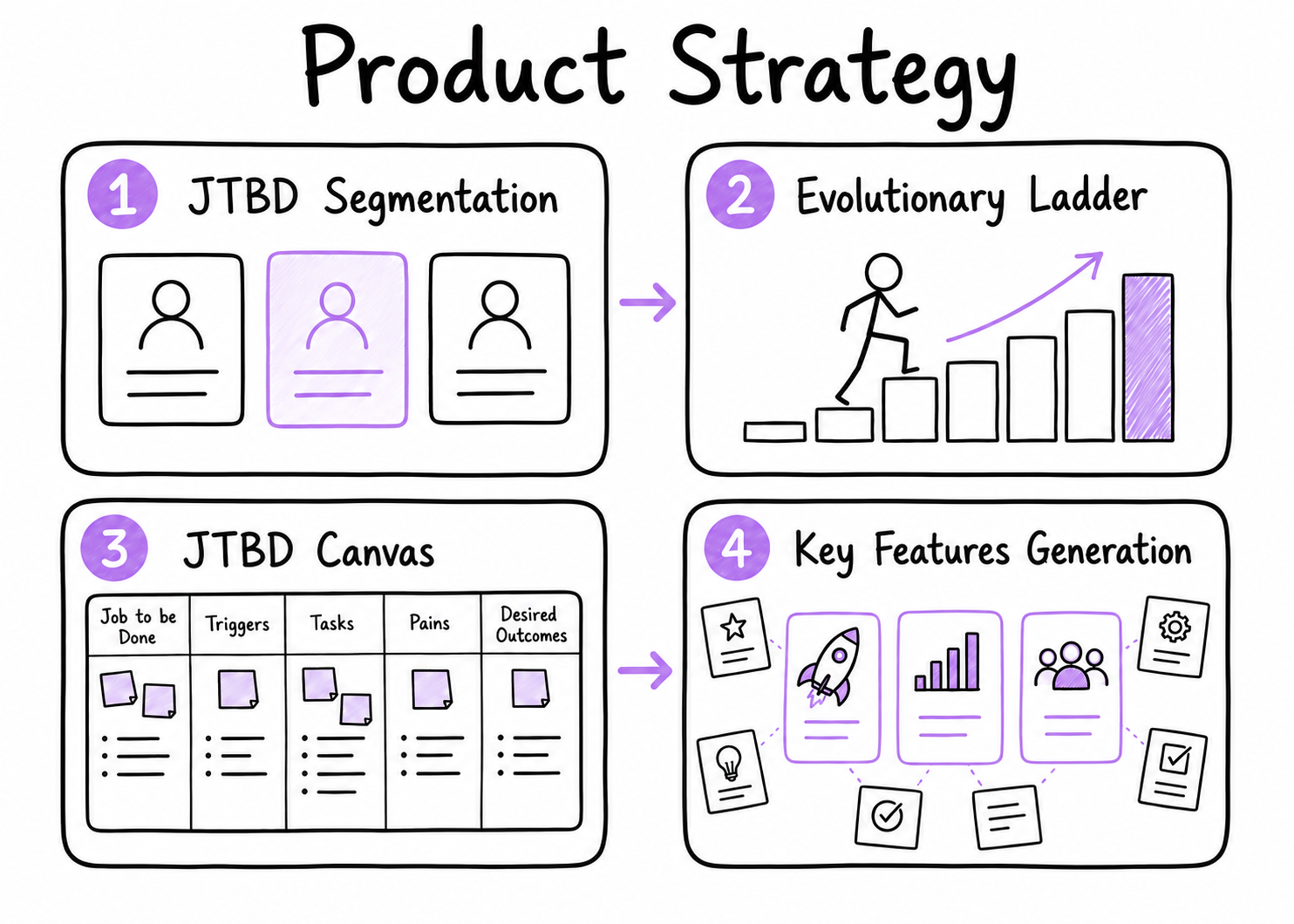
How the chain of reasoning works
- Step 1. JTBD SegmentationGoal: To determine which segment is worth building a product for.
Result: A selected segment with a strong job-to-be-done and clear potential. - Step 2. Evolutionary LadderGoal: To determine what next level of value the product should provide to the customer.
Result: The selected stage of the customer’s evolution that the product should “reach.” - Step 3. JTBD CanvasGoal: To capture the actual logic behind customer behavior: tasks, fears, triggers, and critical sub-tasks.
Result: A customer journey canvas and a set of key tasks that the product should address. - Step 4. Key Features GenerationGoal: To identify not a large list of features, but the core of the product.
Result: 3–5 key features that actually define the value of the solution. - Step 5. Product One-PagerGoal: To develop a clear, cohesive concept for the product that can be defended and further scaled.
Result: A comprehensive Product One-Pager including the target segment, value proposition, core features, and growth strategy.