AI playbook:
Growth Hacking Sprint
How to find product growth opportunities and develop hypotheses that actually drive metrics?
In just one day, the team identifies pain points in the customer journey, turns them into solid growth ideas, and puts together a clear experiment roadmap—what to test first to scale faster.
Growth Hacking Sprint
How to find product growth opportunities and develop hypotheses that actually drive metrics?
In just one day, the team identifies pain points in the customer journey, turns them into solid growth ideas, and puts together a clear experiment roadmap—what to test first to scale faster.
If you are facing these issues...
- Metrics plateau: DAU/MAU, conversion, and retention haven’t grown in months—the “quick wins” are over, and systematic experimentation is needed.
- CAC has increased, channels are burning out: acquisition costs are rising, and the funnel is leaking at every step—it’s crucial to identify bottlenecks fast and target them with precise hypotheses.
- Experiments exist, but there are no results: ideas are chaotic, launched “on a whim,” and debated based on personal preference—a unified format for hypotheses and strict prioritization are needed.
Who is this for
Methodological framework of the playbook
- Product/Marketing, Growth Lead, CRM, Performance, Analytics, Customer Experience.
Methodological framework of the playbook
- Customer Journey Mapping (CJM)
- Jobs To Be Done (JTBD)
- Growth loops & growth mechanics
- ICE prioritization
- AARRR framework
How the chain of reasoning works
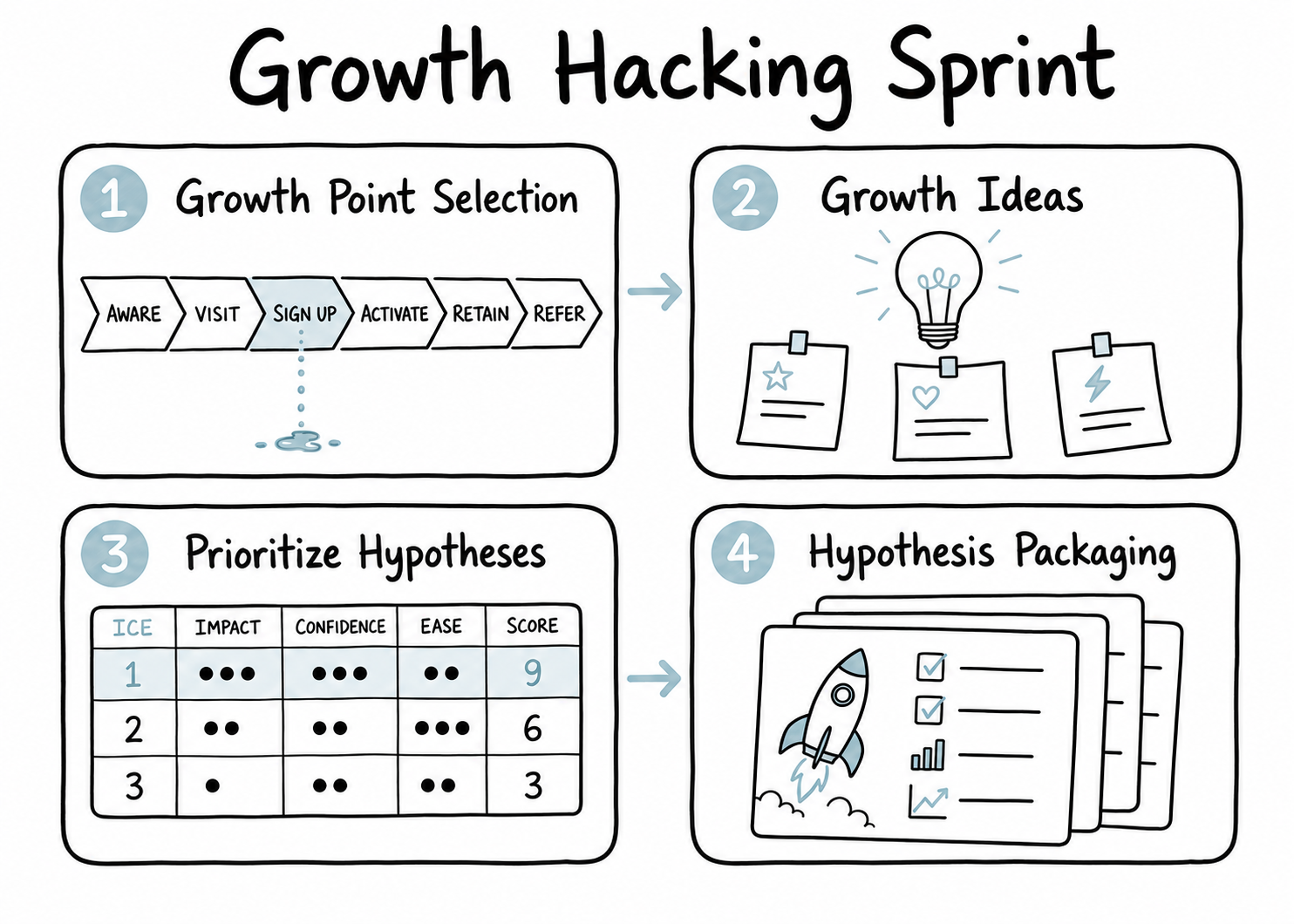
- Step 1. Growth Point Selection (CJM)Goal: Identify the stage in the customer journey where the most revenue and conversions are lost.
Result: A selected CJM stage with identified barriers and growth points. - Step 2. Growth Ideas GenerationGoal: To generate solutions that remove key barriers and drive metrics.
Result: A list of growth ideas (5–10 hypotheses) tied to the selected stage. - Step 3. Hypothesis Prioritization (ICE)Goal: To focus on hypotheses with the greatest impact and the fastest launch.
Result: A list of prioritized hypotheses rated on Impact, Confidence, and Ease. - Step 4. Hypothesis PackagingGoal: To turn ideas into specific experiments ready to be launched immediately.
Result: Hypothesis cards in the “if → then” format, including metrics, a channel, and a test scenario.