AI playbook:
Foresight session
How to determine where the market is actually headed and what will enable the company to succeed in the future?
In just one day, the team builds a vision of the future: selects a market scenario and the company’s role, and formulates a growth strategy with key drivers.
Foresight session
How to determine where the market is actually headed and what will enable the company to succeed in the future?
In just one day, the team builds a vision of the future: selects a market scenario and the company’s role, and formulates a growth strategy with key drivers.
If you are facing these issues...
- The market is changing too fast: lots of signals, trends, and hypotheses, but the team lacks a shared vision of the future.
- Strategic discussions stuck at the level of ideas: lots of talk about the market and opportunities, but it’s still unclear what exactly the company believes in and what role it wants to play.
- The team can’t agree on priorities: some are pushing for products, others for channels, and still others for new scenarios—but there’s no unified growth strategy.
Who is this for
Methodological framework of the playbook
- CEO / Founders
- Strategists / Strategy Office
- CPO / Division Heads
- The top team responsible for establishing a unified growth strategy
Methodological framework of the playbook
- Trend analysis
- Scenario planning
- Future-back thinking
- Growth strategy design
- Business model design
How the chain of reasoning works
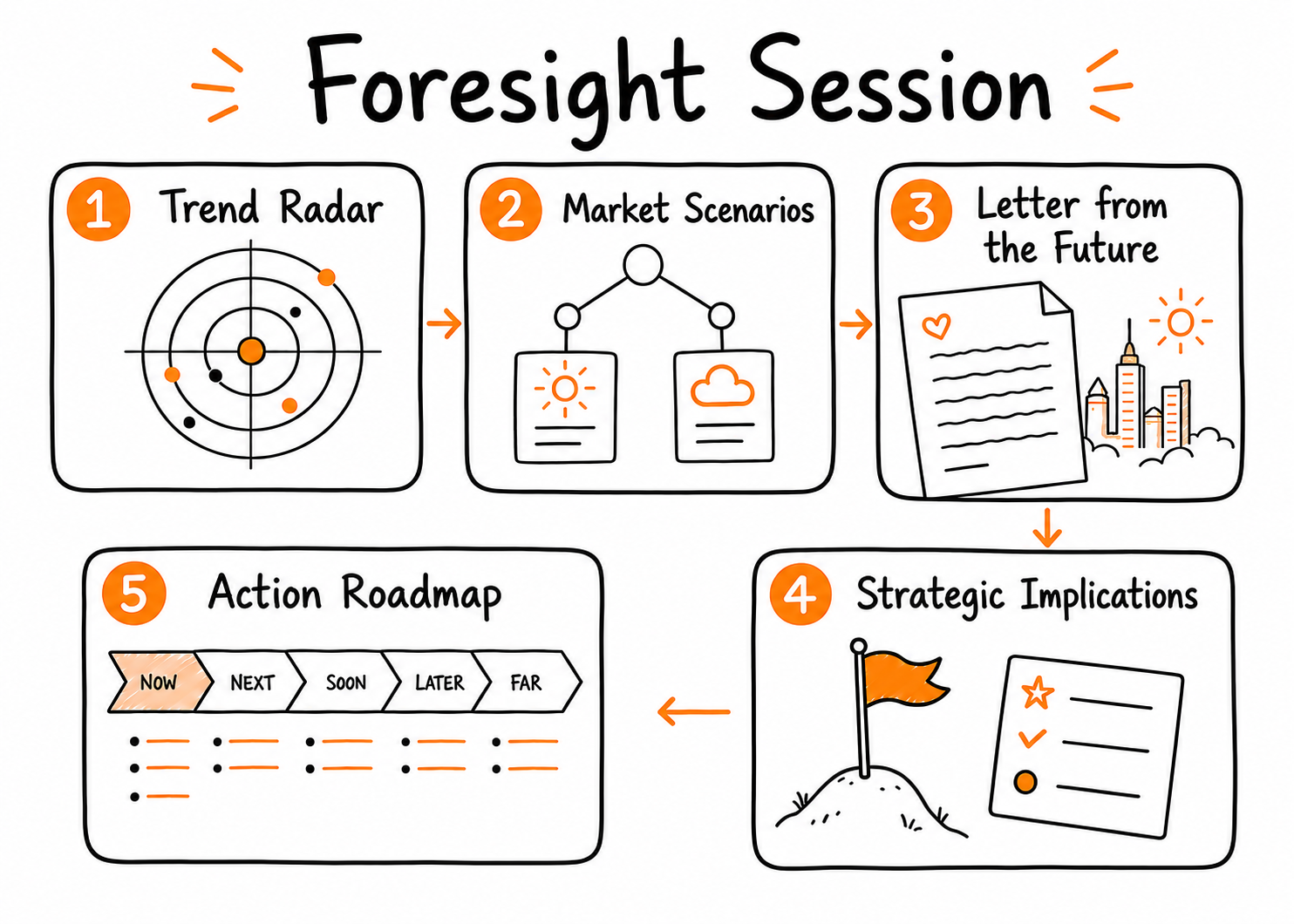
- Step 1. Trend RadarGoal: To identify not just any signals, but the changes in the market, customers, and competitive landscape that are crucial to the business.
Result: A prioritized list of trends that the team considers significant and credible. - Step 2. Market ScenariosGoal: To distill a multitude of trends into a few key options and identify clear scenarios for the future.
Result: Selection of 2 possible market scenarios. - Step 3. A Letter from the FutureGoal: To make the chosen scenario concrete and experience it as a reality, rather than an abstract hypothesis.
Result: A vision of the future market, customers, competition, and the company’s place in this world. - Step 4. Strategic ConceptGoal: To define what the company believes in, what role it wants to play, and why it is positioned to succeed in the chosen future.
Result: A clearly articulated strategic concept for the company within the chosen scenario. - Step 5. Growth DriversGoal: Break down the strategic idea into specific mechanisms that actually drive growth.
Result: A set of growth drivers—products, scenarios, frameworks, and actions—that support the chosen strategy. - Step 6. Business FormulaGoal: To bring everything together into a coherent framework and identify the recurring drivers of the company's growth.
Result: A business formula that explains what drives the company's growth, what enhances performance, and what creates friction.