AI playbook:
Customer orientation and sales
How to reposition a product so that customers see its value and sales grow without discounts?
In just one day, the team develops a value proposition:
identifies the real problem the customer is solving, what is preventing them to make a purchase, and what product positioning actually boosts sales.
Customer orientation and sales
How to reposition a product so that customers see its value and sales grow without discounts?
In just one day, the team develops a value proposition:
identifies the real problem the customer is solving, what is preventing them to make a purchase, and what product positioning actually boosts sales.
If you are facing these issues...
- Sales stopped, and the reason is unclear: conversion rates and average order value are dropping, managers blame “the market,” and the same thing comes up in every call—the customer doesn’t see the value.
- The product launch/relaunch failed: marketing generated leads, but deals aren’t closing—the offer isn’t resonating and doesn’t address the customer’s actual need.
- A strong competitor or copycat emerged: the features are similar, and a price war is beginning—the value must be repositioned urgently so that success isn’t driven by discounts.
Who is this for
Methodological framework of the playbook
- CCO/Sales Director, Product Marketing, Product Owners, Customer Experience.
Methodological framework of the playbook
- JTBD segmentation
- Outcome-Driven Innovation (ODI)
- Value Proposition Design
- Aha moment / activation design
- Sales One Pager
How the chain of reasoning works
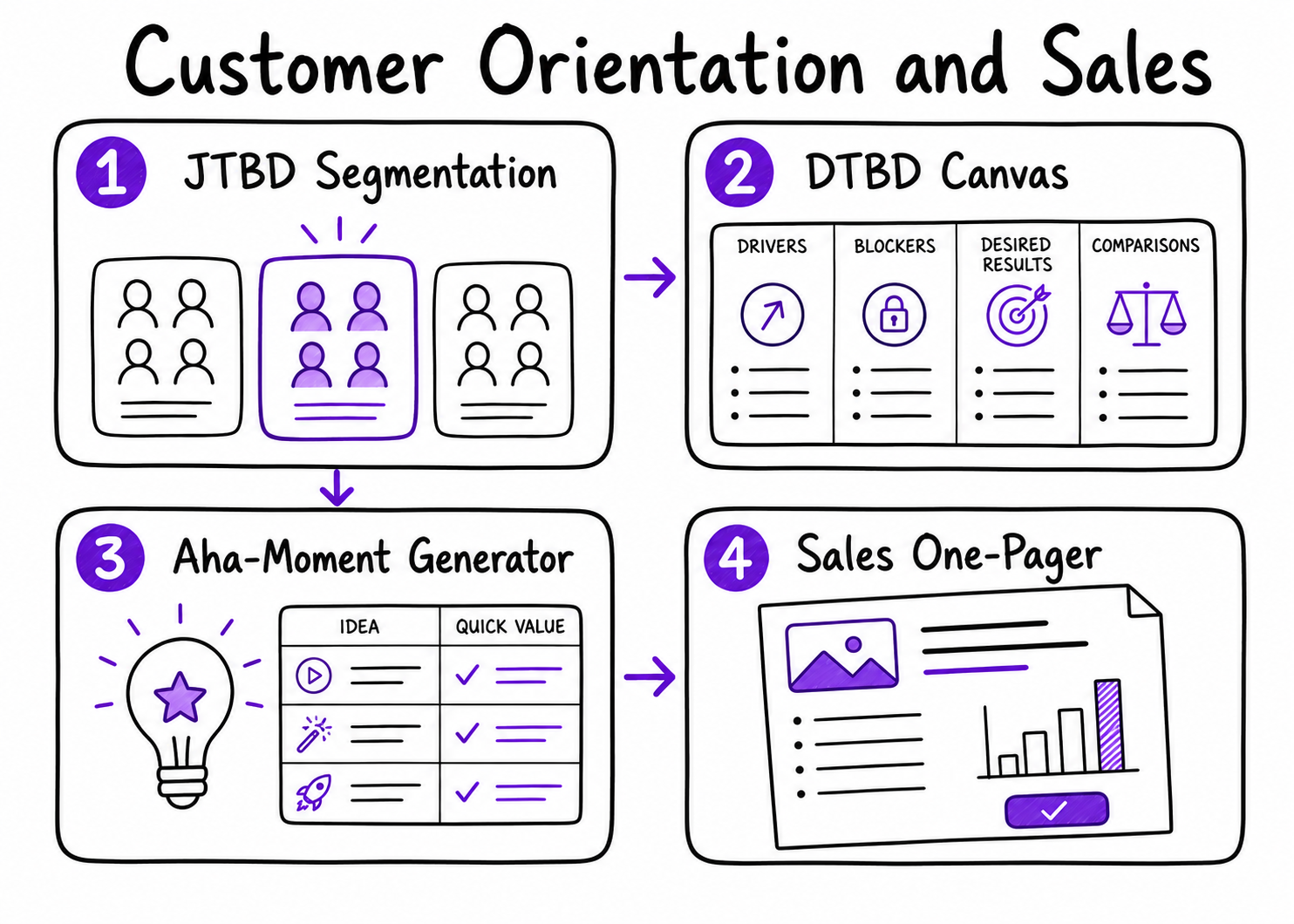
- Step 1. JTBD SegmentationGoal: To identify the real customer jobs that exist in the market and where the product has the best chance to succeed.
Result: A selected segment with a strong customer job and clear potential. - Step 2. DTBD CanvasGoal: To analyze how a customer’s purchasing decision works: what drives them, what holds them back, what results they want to achieve, and what they compare the product to.
Result: 5–10 factors influencing the decision to buy or not buy the product, along with hypotheses about new value propositions. - Step 3. Aha-Moment GeneratorGoal: To design a mechanism that allows customers to see the value of the product quickly and clearly before making a purchase.
Result: A table of aha-moment mechanisms, including value validation logic, aha-moment phrasing, a call-to-action (CTA), and a selection of the priority mechanism. - Step 4. Sales One-PagerGoal: To develop a clear, compelling sales narrative that connects the customer’s situation, the new value proposition, supporting evidence, and the next step.
Result: A Sales One-Pager that includes the value proposition, key selling points, an explanation of “how it works,” and a ready-to-use call-to-action (CTA) for marketing, landing pages, or sales.